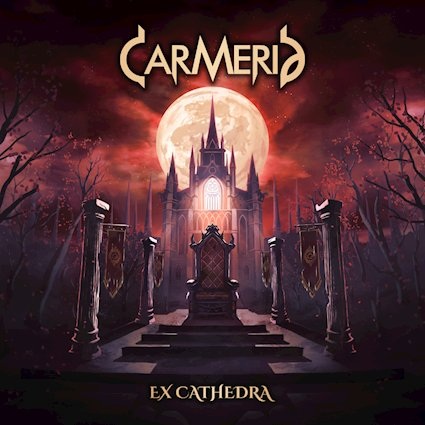
CARMERIA will release their third studio album, Ex Cathedra, on October 30, 2026. The independent band from Australia’s Blue Mountains connects the record’s themes of suffering and resilience with its listener community, including an accompanying video for second single “Unto the Dawn” featuring members of that community.
Written and arranged by vocalist Jordan von Grae, “Unto the Dawn” draws on his experience supporting a close friend through a difficult period. Its focus is on accompanying someone through pain and easing its burden. According to the announcement, the song also acknowledges listeners who have told CARMERIA that their music helped them through difficult experiences.
Members of the band’s Patreon community, The Carmunity, participated as extras in the video, filmed by Greg Oroth at VAMP by Lisa McGuigan. Some travelled more than 1,000 kilometres to take part. That involvement gives a direct connection between the song’s subject and the people it addresses.
The wider album brings a stronger melodic rock influence into CARMERIA’s symphonic metal and gothic rock foundations. Von Grae describes its combination of darker subjects and energetic melodic songwriting as “Misery You Can Dance To.” Its central statement is: “Suffering is the inheritance of every living thing; despair is not.”
The announcement explains Ex Cathedra as “From the Chair,” referring to a statement delivered with complete authority. Here, that framing applies to the record’s declaration about suffering and the possibility of finding joy, love and connection despite it. The band also selected a quotation attributed to Khalil Gibran to express the theme: “The deeper that sorrow carves into your being, the more joy you can contain.”
The opening title track establishes that premise instrumentally. Guitarist Jerry Zahija composed the orchestral introduction and arranged it with Robert Ianni, with additional production by von Grae. Orchestra, pipe organ, harpsichord, cinematic percussion and effects introduce the Gothic and vampiric masquerade imagery described in the announcement.
“Wings,” the first full-band track and the first song written for the album, began as an instrumental demo by keytarist Mishka Bobrov. Von Grae added sections, vocal melodies, lyrics and the final arrangement. Drawing on his work as a mental health support practitioner, its lyrics examine compassion fatigue, the guilt of being unable to save someone and the consequences of neglecting one’s own wellbeing.
Music itself becomes the subject of “The Ashenheart.” Its initial rhythm came from a dripping shower tap that von Grae briefly mistook for piano chords while waking during the night. He developed the idea into chords and melody, then used the song to explore music as an outlet for expression and a possible avenue for healing.
The album’s first ballad, “Embrace the Moon,” was written for his wife, Angharad “Anni” von Grae, whose backing vocals appear in its choruses and quiet bridge. The song considers how love can reveal qualities someone struggles to see in themselves. It is the second part of his planned Von Grae Trilogy, following the 2025 single “Lost in the Snow,” written for his first daughter. The announcement says he intends to write a third song for the couple’s expected second daughter.
“Phantasma” addresses guilt, shame and forgiveness. Primarily written and arranged by von Grae, it incorporates inspiration from a pre-chorus motif and progression in a Bobrov demo. Its subject includes both guilt’s capacity to encourage change and its destructive effects when someone remains consumed by the past or accepts responsibility for things beyond their control.
Written by von Grae and Bobrov, “A Rose Divine” examines the weaponization of belief and the suffering caused when coercion, hatred or violence are justified in defence of something sacred. It was the final song written for Ex Cathedra and is the album’s only track featuring harsh vocals.
“Caelira” approaches betrayal, disillusionment and the damage ambition can cause to trust. Von Grae originally intended its early instrumental demo for his other band, Bad Moon Born. Its title names a weapon in a novel he is writing; the working title remained as the lyrics developed around anger, loss and letting go.
“Shadows in the Sunlight” returns to The Carmunity, addressing the value of shared understanding when suffering cannot be avoided. One of the earliest songs written for the album, it includes additional vocals from von Grae’s sister, Holly Hare.
Lindsay Schoolcraft contributes guest vocals to closing track “Echoes of the Dream.” Bobrov’s original piano piece followed the death of his pet ferret, Mushu. Von Grae developed the writing and arrangement but struggled to move the lyrics beyond the first verse. Approximately a year later, after studying grief and learning that someone close to him had received a terminal diagnosis, he returned to the song.
The finished piece takes the form of a dialogue between a bereaved person and someone they have lost. Its second voice encourages the bereaved to find peace and continue living, closing the record’s exploration of suffering without suggesting that every loss can be undone. Robert Craig contributed additional piano arranging.
Von Grae principally wrote the album and handled lyrics, arrangements, production and mixing at Studio von Grae. The recording credits list him on lead vocals, harmonies, choirs and programming; Zahija on lead and rhythm guitars and solos; and Emma Louise Nagy on bass, acoustic guitars and additional vocals. Bobrov contributed songwriting to “Wings,” “Phantasma,” “A Rose Divine” and “Echoes of the Dream.”
Drums, keys, synths and orchestration were programmed by von Grae, except the title track’s orchestra, programmed by Zahija and Ianni. Vocals were recorded at Studio von Grae, guitars at Zahija’s Casa Noctem, and Nagy’s parts at ELN Studios. Voya at Morava Audio handled guitar and bass re-amping, with mastering by Miro Mastering. Ianni also receives an additional orchestral arranging credit on the title track.
The album and single covers were designed by von Grae, illustrated by Hassane and coordinated by Bobrov. Album photography is credited to Matt Bartolo.
CARMERIA formed in Sydney in 2012. Following the original lineup’s dissolution in 2013, Zahija and von Grae rebuilt the project in 2014; Bobrov joined in 2018 and Nagy in 2021. Their releases include the 2013 debut EP Awakening, first full-length Advenae in 2021, second album Tragédie D'amour in 2024 and the 2025 EP Trinity: Volume I. The band remain independent, with members involved in production, visual design and the business alongside their musical roles.